

What the sources report
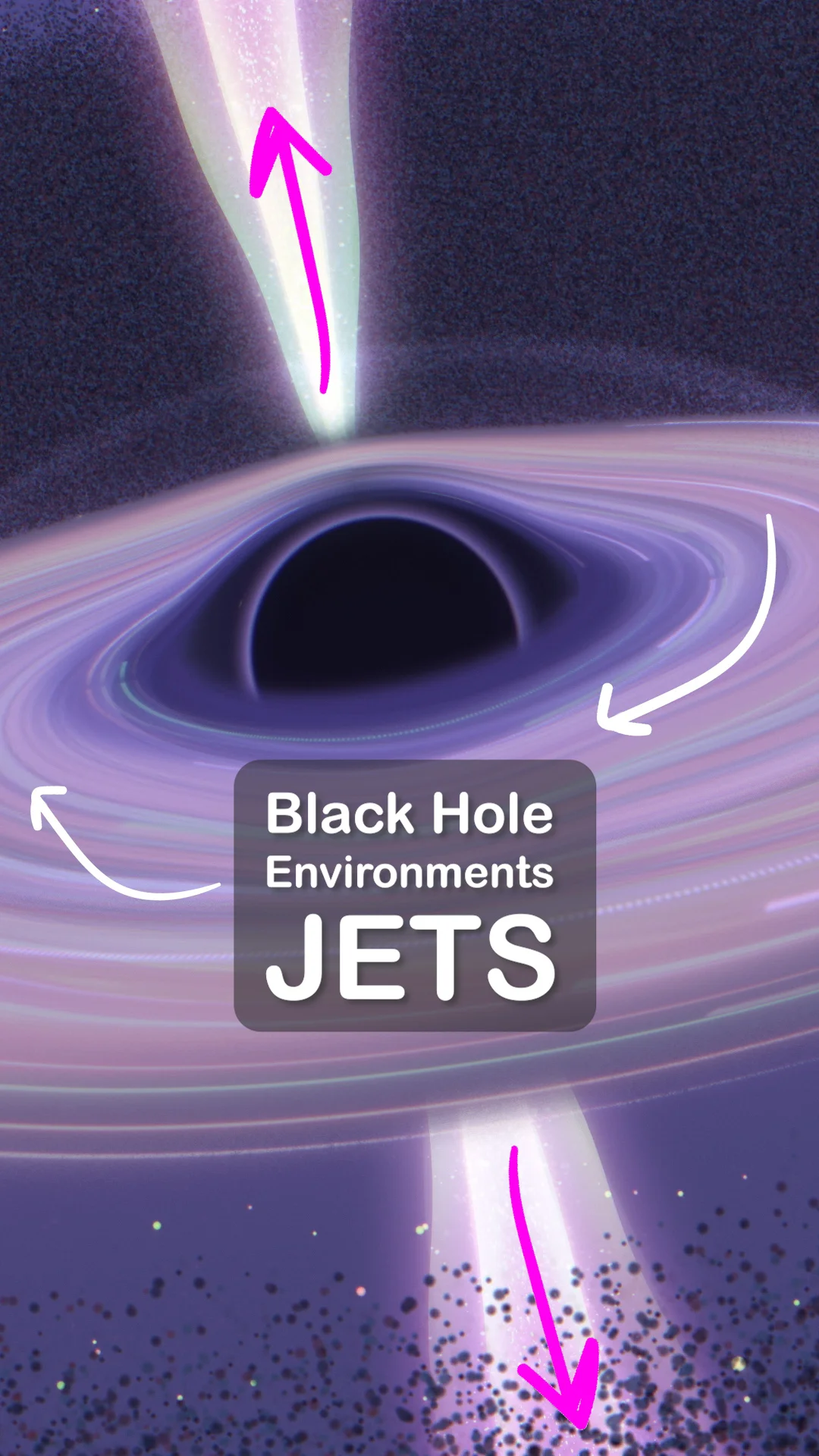
SciTechDaily reports that delayed jets appeared when modeled feeding rates fell to approximately 2 percent of the Eddington limit, a threshold it also associates with stellar-mass black holes.
SciTechDaily ↗SciTechDaily distinguishes an early jet phase during rapid feeding from a delayed phase hundreds to thousands of days after a star’s disruption.
SciTechDaily ↗Universe Today and ScienceDaily describe stronger H-alpha emission along radio-jet axes in combined observations of hundreds of galaxies.
Universe Today ↗ ScienceDaily ↗Universe Today discusses both stimulated and suppressed star formation; ScienceDaily emphasizes how heated gas may fail to cool and flow into galaxies.
Universe Today ↗ ScienceDaily ↗What remains unclear
The supplied SciTechDaily account does not establish that the proposed feeding-rate threshold applies to every black hole or tidal disruption event. [163]
The gas-emission measurements do not directly measure subsequent increases or decreases in star formation. Those outcomes are discussed as implications of jets interacting with gas. [164] [165]
The packet does not establish a causal connection between the launch threshold in the first study and the surrounding-gas signals in the second. [163] [164] [165]
How the story is being covered
Full perspective pending.
Political leaning labels describe an outlet’s online news coverage, as rated by AllSides. Center does not mean unbiased; a label does not establish whether a particular report is correct. Compare the linked reports and the evidence below. An absent perspective is not evidence that an outlet did not cover the story.
These accounts are complementary, not competing explanations of one experiment. SciTechDaily emphasizes a possible shared launch threshold across black holes of different masses. Its article is credited to Curtin University, the lead researcher's institution, so it presents an institutional account rather than independent confirmation. Universe Today and ScienceDaily describe the same separate gas study and repeat researcher statements; their agreement is not independent corroboration. Universe Today discusses both possible stimulation and suppression of star formation, while ScienceDaily foregrounds how heated gas might limit galaxies' future fuel supplies. ScienceDaily explicitly uses Arizona State University material. These institutional accounts and researcher statements come from interested primary sources. The comparison spans two distinct research groups, not three independent confirmations.
SciTechDaily
Political leaning: Not rated in our registry
secondary ·Astronomers Discover a “Universal” Trigger for Black Hole Jets ↗
Reporting focusFeeding rates and the timing of jets following stellar disruption.
Framing & contextEmphasizes a possible common transition across black holes of very different masses, while noting that the finding does not prescribe identical timing for every event.
Evidence group: SciTechDaily. This identifies shared evidence, not editorial independence.Universe Today
Political leaning: Not rated in our registry
secondary ·Galaxy Evolution Can be Affected by Black Hole Jets ↗
Reporting focusInteractions between radio jets and gas surrounding galaxies.
Framing & contextExplores both possible enhancement and suppression of star formation, emphasizing the scale of black holes’ influence.
Evidence group: UNIVERSE_TODAY. This identifies shared evidence, not editorial independence.ScienceDaily
Political leaning: Not rated in our registry
secondary ·Black hole jets may decide the fate of entire galaxies ↗
Reporting focusDirectional ionization of circumgalactic gas and implications for galaxies’ fuel supplies.
Framing & contextForegrounds the possibility that jets prevent gas from cooling and supplying new stars.
Evidence group: ScienceDaily. This identifies shared evidence, not editorial independence.Important context
SciTechDaily says researchers examined 20 tidal disruption events—stars torn apart near supermassive black holes—and narrowed the analysis to 10 with reliably modeled feeding rates and radio-outflow timing. These events allow changes in feeding to be followed over years rather than millennia. [163]
The proposed threshold concerns delayed jets. SciTechDaily also describes an earlier jet phase during rapid feeding; it does not say every event produces a jet at the same elapsed time. [163]
The gas study combined optical and radio observations of hundreds of galaxies. ScienceDaily explains that the faint hydrogen signal became clearer when measurements were combined along radio-jet directions rather than averaged across all directions. [164] [165]
Gas surrounding galaxies can supply material for future stars. Evidence that jets ionize that gas is relevant to galaxy growth, but it is distinct from observing how many stars subsequently form. [164] [165]
Timeline
- ScienceDaily reported the surrounding-gas study, identifying Arizona State University as its source. [165]
- Universe Today covered the gas study and discussed potential consequences for galaxy evolution. [164]
- SciTechDaily published the Curtin University account of feeding rates and delayed jet formation. [163]
Sources & evidence
- Astronomers Discover a “Universal” Trigger for Black Hole Jets ↗
SciTechDaily · Retrieved 2026-10-11 22:50:39 UTC
- Galaxy Evolution Can be Affected by Black Hole Jets ↗
Universe Today · Retrieved 2026-10-11 22:50:39 UTC
- Black hole jets may decide the fate of entire galaxies ↗
ScienceDaily · Retrieved 2026-10-11 22:50:39 UTC
Updates & corrections
- Automated revision; separate Codex quality review passed. Independent fact-check pending. This comparison assesses the supplied accounts; it does not independently validate either study.
- Initial unpublished draft. Source, rights, risk and separate quality reviews remain pending.