
What the sources report
NPR reports that Crew-12 splashed down in the Pacific off Los Angeles on October 8 after nearly eight months aboard the station.
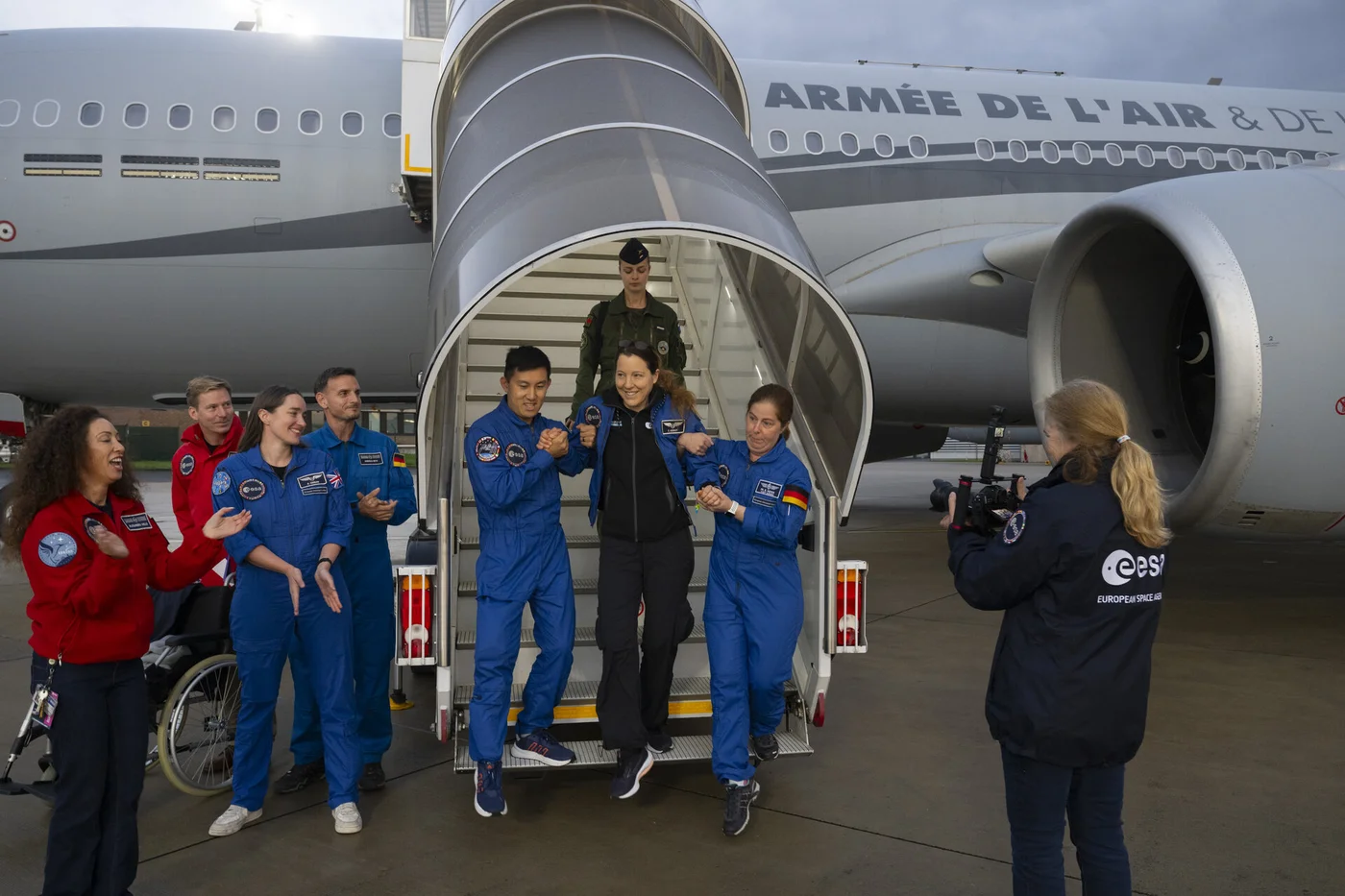
NPR ↗ESA reports that Adenot arrived in Cologne on October 10 following a 237-day mission and says she would undergo postflight data collection and readaptation activities.
European Space Agency ↗NPR explains the capsule’s atmospheric descent and parachute landing, while ESA devotes more attention to Adenot’s European research programme and technology-testing work.
NPR ↗ European Space Agency ↗Both accounts report three spacewalks by Adenot; NPR additionally emphasizes Meir’s maintenance and upgrade work outside the station.
NPR ↗ European Space Agency ↗What remains unclear
The supplied accounts do not independently establish the scientific effectiveness or eventual practical benefits of the experiments they describe. [35] [36]
ESA describes planned postflight activities; the packet does not establish their subsequent completion. [35]
How the story is being covered
Full perspective pending.
Political leaning labels describe an outlet’s online news coverage, as rated by AllSides. Center does not mean unbiased; a label does not establish whether a particular report is correct. Compare the linked reports and the evidence below. An absent perspective is not evidence that an outlet did not cover the story.
The difference is principally scope and timing: NPR covers the crew’s splashdown, while ESA’s later statement follows one astronaut’s homecoming and agency contributions. Their accounts are complementary, not evidence of a factual dispute. ESA is an interested primary source. Shared mission information and NASA-attributed research descriptions are not independent corroboration. This comparison does not address political positioning or infer ideology.
European Space Agency
Political leaning: Primary source — not an outlet rating
primary ·ESA astronaut Sophie Adenot returns from her first mission to the International Space Station ↗
Reporting focusAdenot’s European homecoming, research workload and postflight programme.
Framing & contextAn interested agency account celebrating its astronaut’s achievements and European participation.
Evidence group: ESA. This identifies shared evidence, not editorial independence.NPR
Left-leaning · AllSides: Lean Left · checked 2026-10-10
secondary ·4 people on NASA's Crew-12 mission return to Earth after 8 months in space ↗
Reporting focusCrew return, reentry mechanics, station maintenance and Jessica Meir’s reflections.
Framing & contextAn explanatory and human-interest account of returning from an extended station mission.
Evidence group: NPR. This identifies shared evidence, not editorial independence.Important context
NPR attributes its description of the crew’s experiment programme to NASA, illustrating why separate publishers can still share underlying agency evidence. [36]
ESA describes work spanning materials science, biology and physics, alongside testing technologies for future exploration. That account documents claimed activity rather than published research findings. [35]
Timeline
- ESA dates Adenot’s launch with Crew-12 to February 13. [35]
- NPR reports Crew-12’s Pacific splashdown; ESA also dates the return to October 8. [36] [35]
- ESA reports Adenot’s arrival in Cologne. [35]
Sources & evidence
- ESA astronaut Sophie Adenot returns from her first mission to the International Space Station ↗
European Space Agency · Retrieved 2026-10-11 04:00:26 UTC
- 4 people on NASA's Crew-12 mission return to Earth after 8 months in space ↗
NPR · Retrieved 2026-10-11 04:00:26 UTC
Updates & corrections
- Initial unpublished draft. Source, rights, risk and separate quality reviews remain pending.